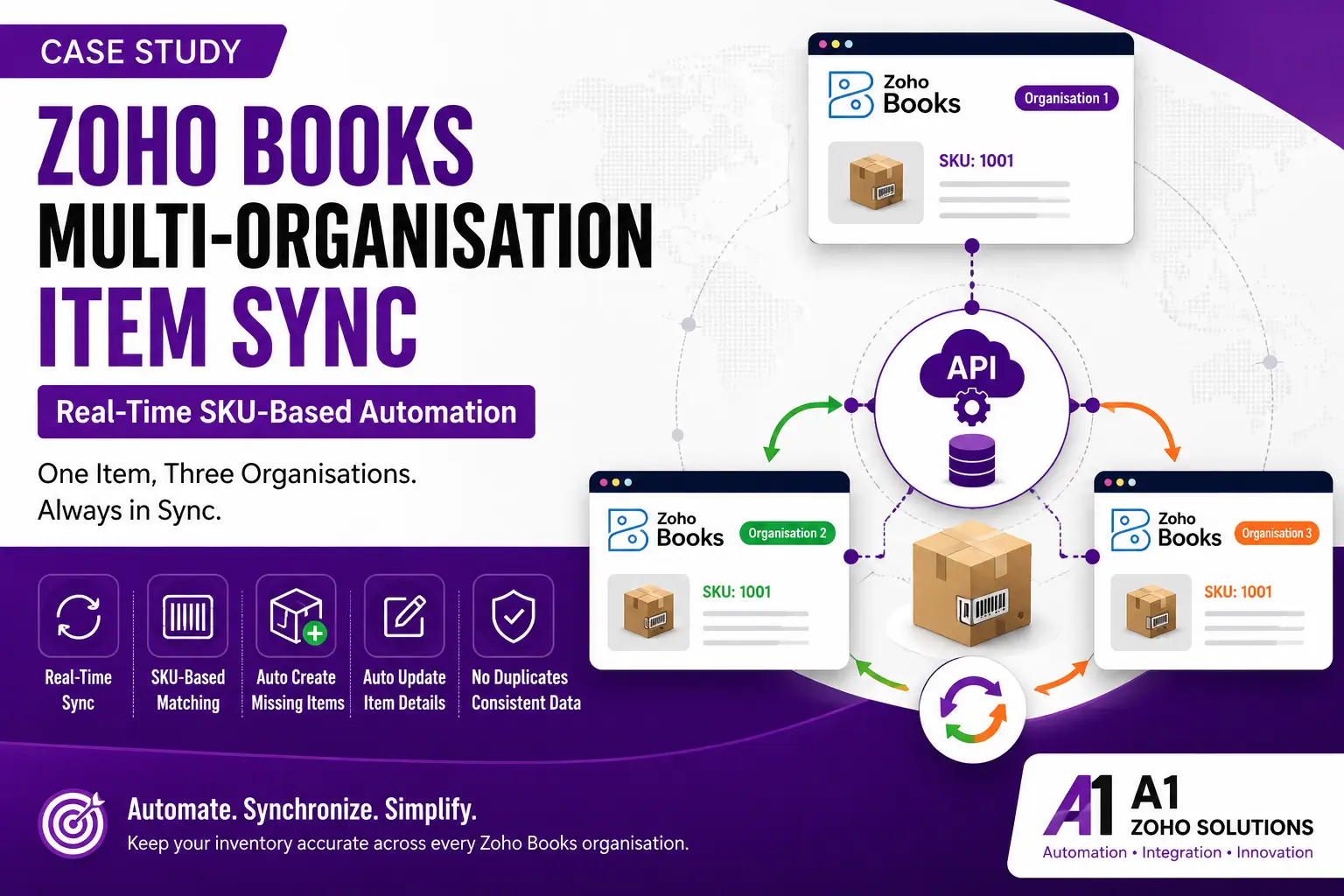
Managing products across multiple Zoho Books organisations becomes difficult when each organisation is updated independently. Businesses often face duplicate work, inconsistent pricing, outdated product details, and inventory mismatches.
A US-based company approached A1 Zoho Solutions with exactly this challenge. They wanted product information to stay identical across three separate Zoho Books organisations without requiring manual updates.
Instead of relying on manual imports or scheduled exports, we developed a custom synchronization system that automatically copied item changes between organisations in real time.
About the Client
The client is a US-based business operating multiple Zoho Books organisations for different business units.
Although each organisation managed its own financial records, all of them shared the same product catalogue.
Maintaining the same product details in every organisation had become time-consuming and error-prone.
Business Challenges
The client experienced several operational issues:
- Product information had to be updated three times.
- Staff sometimes forgot to update another organisation.
- Product names became different between organisations.
- Pricing and descriptions were inconsistent.
- Newly created products were missing from other organisations.
- Manual imports created duplicate records.
- Inventory teams could not rely on identical item information.
As the business expanded, these problems became more frequent.
Project Requirements
The client requested a solution that could:
- Synchronize items automatically.
- Use an existing field to identify matching products.
- Create missing items automatically.
- Update existing items when changes occur.
- Avoid duplicate records.
- Work independently without manual intervention.
- Continue working as the product catalogue grows.
Our Analysis
After reviewing the client’s workflow, we found that every product already had a unique SKU.
Instead of comparing product names, we used the SKU as the single source of truth.
This approach allowed the system to:
- Detect existing items.
- Update only changed information.
- Create new products automatically.
- Ignore unrelated records.
Using SKU also made the synchronization reliable because product names or descriptions may change over time, while SKU normally remains constant.
Solution Architecture
A1 Zoho Solutions designed a middleware service between the three Zoho Books organisations.
The workflow operates as follows:
- A user creates or edits an item.
- Zoho Books triggers a webhook.
- The middleware receives the event.
- The latest item information is fetched through Zoho Books APIs.
- SKU is used to locate matching items.
- Missing products are created.
- Existing products are updated.
- Changes are pushed to the remaining organisations.
The entire process happens automatically without user involvement.
Technologies Used
- Zoho Books API
- Deluge Functions
- REST APIs
- OAuth Authentication
- Webhooks
- Custom Middleware
- JSON Data Processing
Features Implemented
Real-Time Synchronization
Every item update is automatically propagated to the remaining organisations.
SKU-Based Matching
SKU acts as the common identifier across all organisations.
Automatic Item Creation
If an item does not exist, it is created automatically.
Automatic Updates
Changes to names, pricing, descriptions, categories, and other supported fields are synchronized immediately.
Duplicate Prevention
The middleware checks existing SKUs before creating a new product.
API Authentication Management
OAuth tokens are securely managed to ensure uninterrupted communication.
Error Logging
Failed synchronizations are logged for troubleshooting and future retries.
Scalable Design
The solution supports future expansion if additional Zoho Books organisations are added.
Technical Challenges
During implementation, we solved several technical challenges.
SKU Validation
Older records contained missing or inconsistent SKUs.
Validation rules were introduced before synchronization.
API Rate Limits
The middleware was designed to process requests efficiently and avoid unnecessary API calls.
Authentication Renewal
OAuth access tokens expire periodically.
Automatic token refresh logic was implemented to prevent synchronization failures.
Data Consistency
Different organisations occasionally contained modified product information.
Conflict handling ensured the latest valid record became the source of truth.
Business Benefits
After implementation, the client achieved several improvements.
- Product information became consistent across all organisations.
- Manual updates were eliminated.
- Duplicate products were reduced.
- Staff saved significant administrative time.
- Pricing remained consistent.
- New products became available everywhere automatically.
- Inventory teams worked with reliable product information.
- Business growth no longer required additional manual synchronization.
Estimated Outcomes
Although exact numbers are confidential, the client reported improvements in:
- Faster product maintenance
- Lower administrative effort
- Fewer data inconsistencies
- Improved operational efficiency
- Better inventory management
Future Enhancements
Possible future upgrades include:
- Inventory quantity synchronization
- Price list synchronization
- Warehouse mapping
- Multi-country tax handling
- Synchronization dashboard
- Email failure notifications
- Sync history reports
- Scheduled health monitoring
Conclusion
Managing products across multiple Zoho Books organisations can quickly become difficult when every update depends on manual work.
By developing a custom SKU-based synchronization system, A1 Zoho Solutions helped the client maintain a single, consistent product catalogue across three separate Zoho Books organisations.
The solution reduced manual effort, improved data accuracy, and created a scalable foundation that can support future business growth.
FAQs
Why use SKU instead of product name?
SKU is unique and remains consistent, making it a reliable identifier for synchronization.
Does the solution work in real time?
Yes. Item updates are processed automatically after changes occur.
Can it synchronize more than three organisations?
Yes. The architecture can be extended to support additional Zoho Books organisations.
Can custom fields also be synchronized?
Yes. Depending on business requirements, custom fields can be included in the synchronization process.
Does this solution prevent duplicate items?
Yes. The middleware checks existing SKUs before creating new records.